

A series of short essays on how watch cases challenge the notion of form and deconstruct the space.
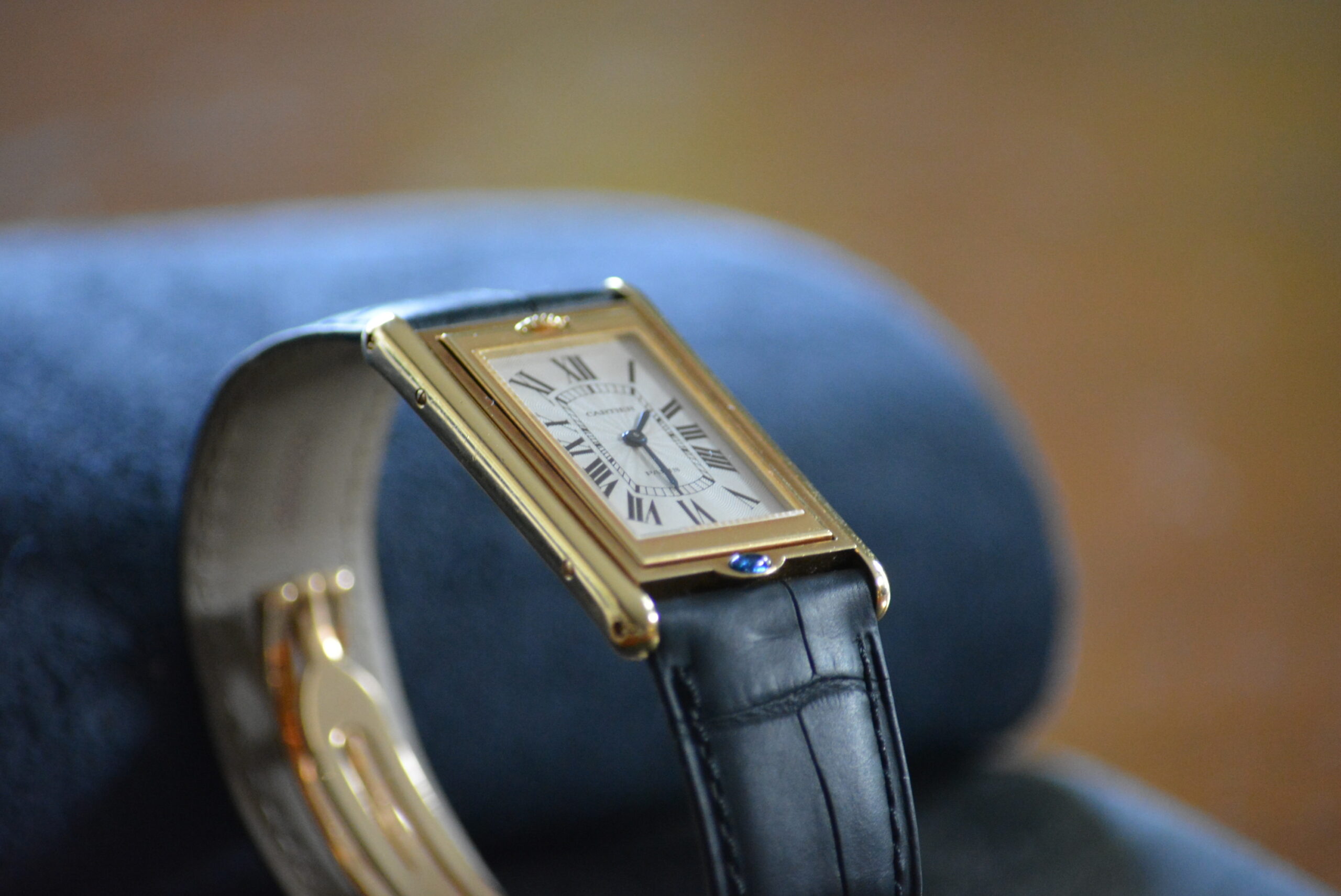
Cartier Tank Basculante, 1985. Time is all We have
Cartier Tank Basculante 1985. Hour-Minute. Guilloche sunray dial. Bec d’Aigle. Blue hands. xx/91 limited series. Manual winding, caliber Piaget 40P, D14.2 H 2mm, 36h power reserve. Case 22mm by 37mm lug to lug. 18mm lugs. 5 mm thickness.
Published in “Le Temps de Cartier” Barracca Negretti Nencini 1989 p.344.
Well well, where we left. The deconstruction of the form is not a unique thing in the design of objects, architecture, and fashion. Relatively to the watch world only few examples are more or less known, assumed often their deconstructioning process is little understood or known. One of such examples is the Cartier Tank Basculante, a creation of the genius of cases of watches: Louis Joseph Cartier. The Basculante is an example of representation of deconstructivism, but in this instance “dynamic”. In motion. Indeed the real deconstruction of the form is within the act of flipping the dial . In the series of moments preceding the action of folding -for protection- the watch case deconstructs itself to resurface transformed, yet again itself. In the dynamic act of changing the form destructure itself to recompose. It is such a beautiful acrobacy, that we are left to observe it for a few moments, before all got quiet as it was. As a beautiful metaphor of life and changing. The dynamism of form, expressed in the act of changing. Only in that instant we perceive the balance of the time, in which the more internal frame balance itself in an imperfect equilibrium before descent in is oblivium: the stasis. Then we forget what it was and what it became, to begin the new normality. A floating volume that acrobatically rotates in space around the main case, revolving around the axis 9-3.
We speak of deconstruction of the case because the case itself on the “dial swapping” process decomposes in mid air. It seems to explode in linked frames entangled by unseen pins keeping together the exploded geometry in space. The modest volume of the case expands in space projecting beyond the firm case sitting on the wrist. And for a moment we wonder if it is going to fly away. I believe there are few watches around looking so modest and shy when comfortably laied on your wrist, yet vigorously expressive when in the act of changing shape.
It is without doubt a marvel that such a watch saw its light in 1932. In a time in the mid of the art deco period, while the watch would comfortably belong to a later (1940) Abstract Expressionism era, where painters like Jackson Pollock and Mark Rothko began dematerializing form in painting and talking about dynamism and motion. What better words would describe this watch if not those same – ten years later- of Pollok describing his own art: ”motion made visible memories, arrested in space”.
It is peculiar that the first “Cartier Tank Basculante” appeared when Louis Cartier was an already a mature designer and entrepreneur, at the turning of his life. A time when possibly the maturity of his taste has turned into abstracting details of its ingenuity. He himself stated the Tank was among his best creations, prones to embody different forms and variations.

We are left with its pure form, a Tank, in the process making us understand its true nature. We see only traces of what is left. A frame within another frame, with a different treatment of the surface. One polished , the other vertically brushed. We do perceive something is off. We see three frames embracing one only dial. Are those traces left by the cinetic motion? Those are as much as signs left by Pollok in a canvas, than signs left by Louis in a form. An abstract, clear sign that we could think out of place, motivated by something. Only time will tell.
This is one of the reasons I love Cartier. It anticipates time, it precedes time, it persists in time. It looks old but modern. It looks vintage but contemporary. It rides time like the foamy crest preceding the wave at the shore.
I love Tanks in general, even if I don’t own one. They are generally very simple to dress and bring around. They are not pretentious and they don’t let you down, with a tie or shirt. Nevertheless this one greatly surpasses the “Tank”, going beyond its material limits.
Such an example sets itself so much apart from a static decomposition of volume and space, that time forcefully plays its role. Yet it is also the key to understanding its form into the deconstruction of it.