


At this point you will think I am redundant. I often speak about Gerald Genta and its contribution. I did so but I purposely did not enter into details of the most famous, and advertised at this point in history, of its creation. For two basic reasons I will not write about the Royal Oak and the Nautilus. First they have been largely covered by many: adding something else is irrelevant as a contribution from what you can find elsewhere around. Moreover I think at this point they are slightly overrated. For second, people have been overfed by massive advertisement campaigns of Audemars Piguet and the Patek Philippe. I believe they have grown tired of talking about Gerald Genta and his achievement about this two only watches. Nonetheless, I believe Genta has been more than what we talk about. Not because he has been a lesser master in eclecticism or innovation than it is, but because he not only adventures in experimentation bridging collaboration that today we enjoy in lots of watch brands, but also because in his role as watch designer and cross breeding creator, he has been instrumental in officially write it down in the hall of fame the figure of watch designer and artisan of watchmaking.
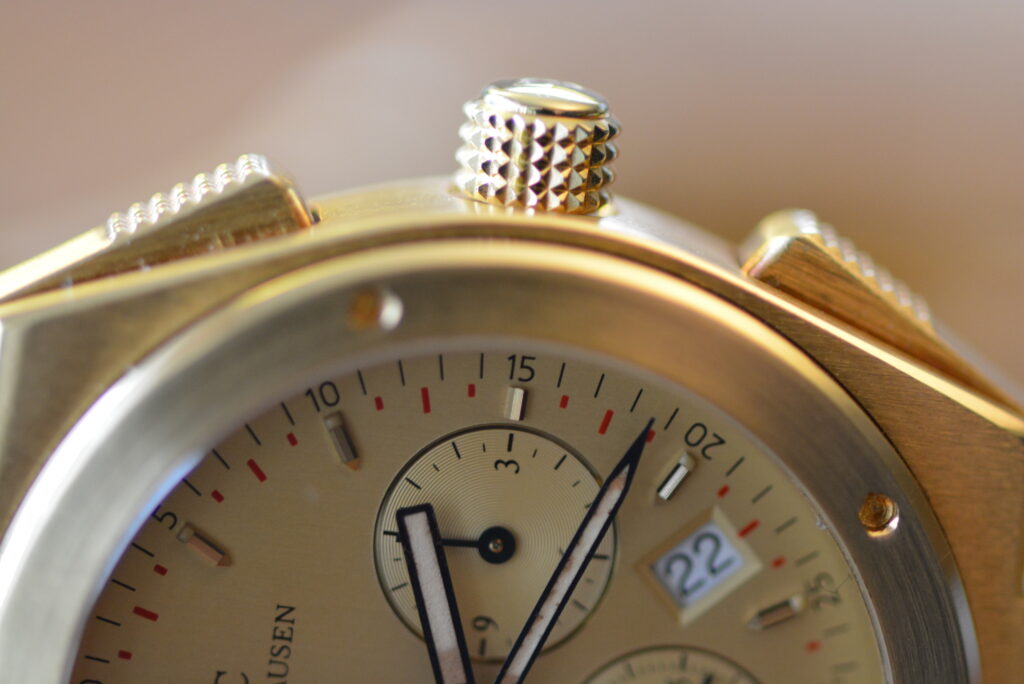
Guilloche counter finishing in contrast with circular brushed and highly polished edge of the bezel.
I myself cannot believe that when I am looking around for watches, finding some with a peculiar level of detail and attention, I generally end up to realize it has been an object of revisitation by Genta himself. The one I am going to present is one of those. It called me out by surprise. I could see it had some particular features, uncommon in other watches around. And I was pleasantly surprised to understand, later on, that Genta gave its touch to it. We are talking about the Engeniuer. But not the over spoken revisitation. With no surprise the model of the IWC Ingenieur has been a target of the hand of Genta. Yet in almost 20 years from its launch, I believe Genta did not really intervene in all its variations or iterations. That are many. It may be possible he gave overall suggestions otherwise taking some distance from its development over the years. My guess is he was very busy with its own professional achievements, not the least its own brand “gerald genta” and a future enterprise “charles genta”. It is therefore understandable he had likely little or no time to dedicate to consulting for other firms. Yet in this model you can see some details that set aside from the average of models of the decade before.
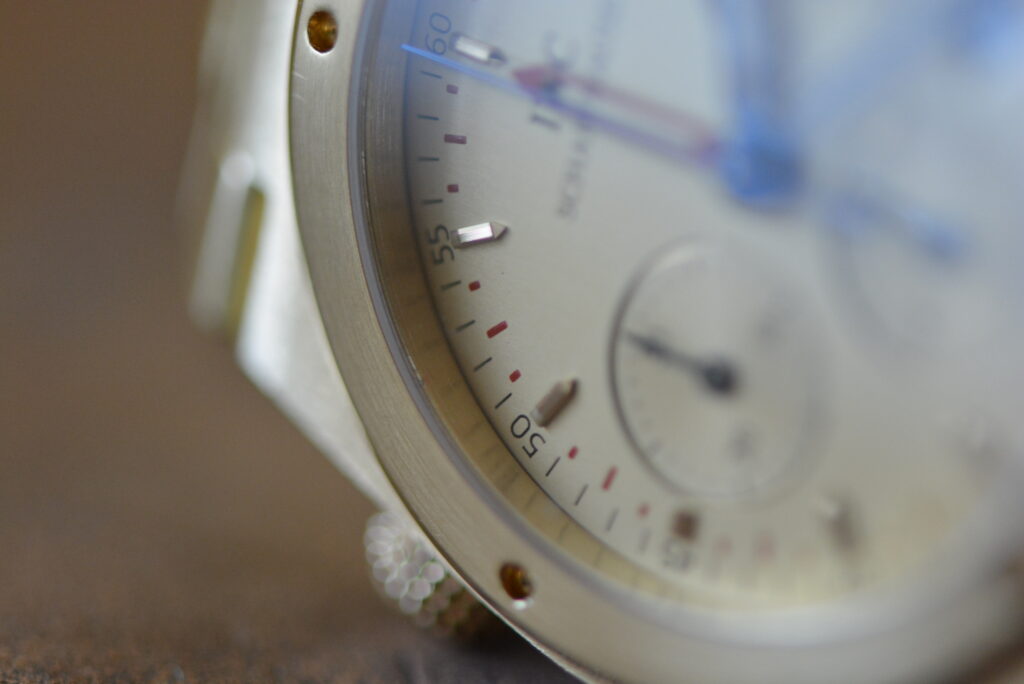
For starters, the choice of finishing in the polishing is not trivial at all. A succession of different treatments for the surfaces is given. From the highly polished border of the bezel, to the circular brushed surface of the slightly curved top of the bezel. From the brushed vertical surface of the top of the case, to the highly polished border of the watch case. Further from the case to the bracelet: a dialog with light reflections, not leaving space to parts less treated or after thought.
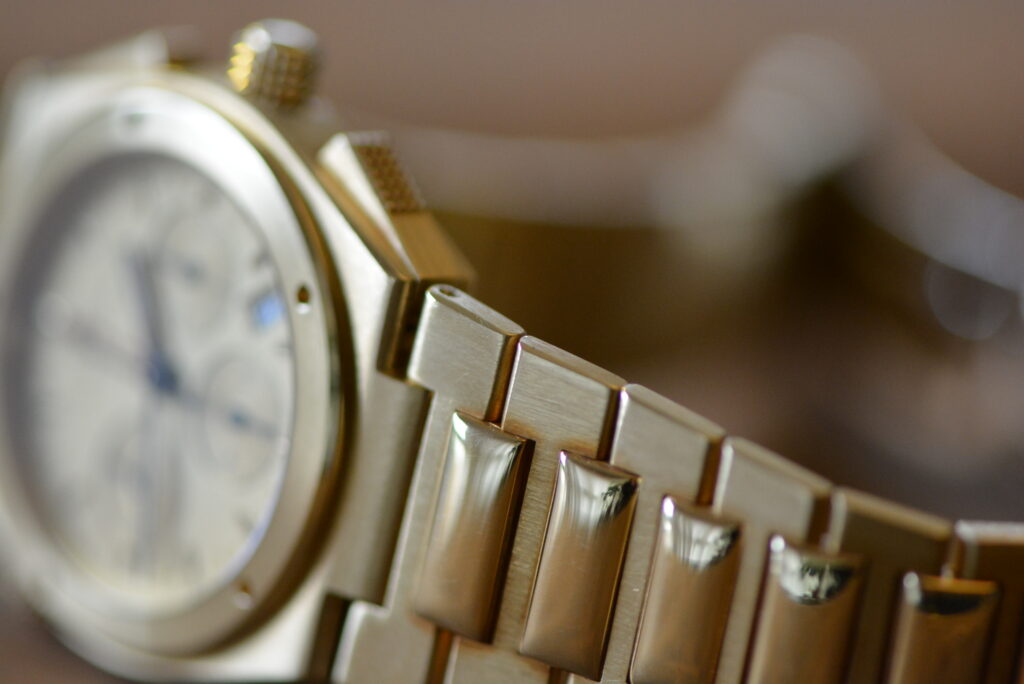
Different surface treatment: vertical brush and highly polished surfaces,
The bracelet for example accounts alone for three different finishes that play with light and thickness, or thinness, of the C section links of the bracelet. The choice of bumped polished surface exacerbate the effect making even more protruded than what they are. In the case of the bezel, slightly tilted toward the outside and with a concentric circular brushed finish, it is surrounded by a highly polished border than close down toward the slightly curved barrel shape of the 34 mm sixties case. A case design to be integrated with the bracelet but that leaves space – in favor of a less complex manufacturing process- to adjust the same case to a variation of the proposed watch with leather strap and end-links. The latest being the version in steel with leather strap.
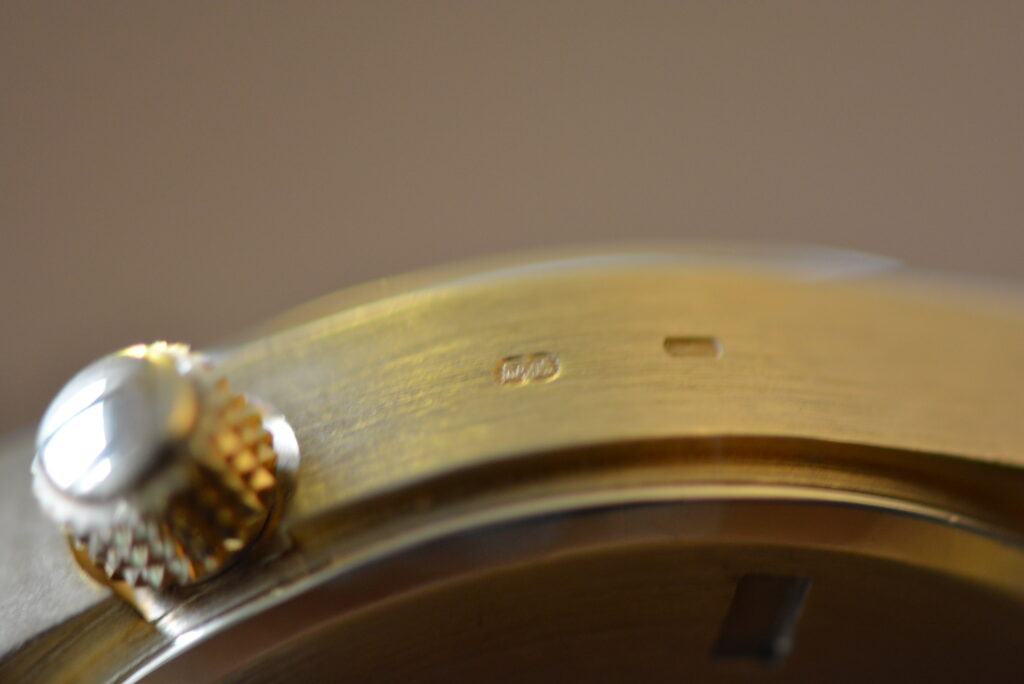
Alarm pusher crown ON/OFF setting and time setting with Clou de Paris grip. Two hall mark stamped for 750 gold (18k) case
The watch comes in a particular configuration: a chronograph with alarm. At a first glance the fourth hand looks like a GMT hand, but the impression is soon disguised by the presence of an asymmetrical pusher at 10 o’clock, which activates the alarm. The red -not lumed- hand well overlaps to the -lumed- hour hand, little interfering while overlapping. The truncated hour hand end where the date windows cut out the dial at four thirty position, Three counter, running second 30 minute counter and twelve hour counter symmetrically define the dial distribution.
The movement choice also diverges from choices made years before. Another point to take into consideration, evaluating the departure from references before. While few references before the watch mounted a caliber based on an ESA quartz cal 956-111, this one instead opted for a more refined quartz movement: the JLC caliber 630, a compact quartz watch movement with a mechanical chronograph developed by Jaeger-LeCoultre and used by IWC. The movement, introduced in 1987, was the first member in the Jaeger-LeCoultre Mechaquartz family. A complicated movement, with 25 jewels, considered revolutionary since its thinnes measuring just 23.30 mm diameter and 3.70 mm thick. This made it 1/3 the volume of most contemporary chronograph movements and 40% smaller than the smallest equivalent movement on the market. Two motors in the caliber: one powers the main timekeeping hands at a frequency of 1 Hz; while the second powers the mechanical chronograph at 4 Hz. Since the chronograph is mechanical, it has the same feel as a conventional chronograph movement, including mechanical zero reset. Yet the Mechaquartz was much more compact than a conventional automatic chronograph movement.
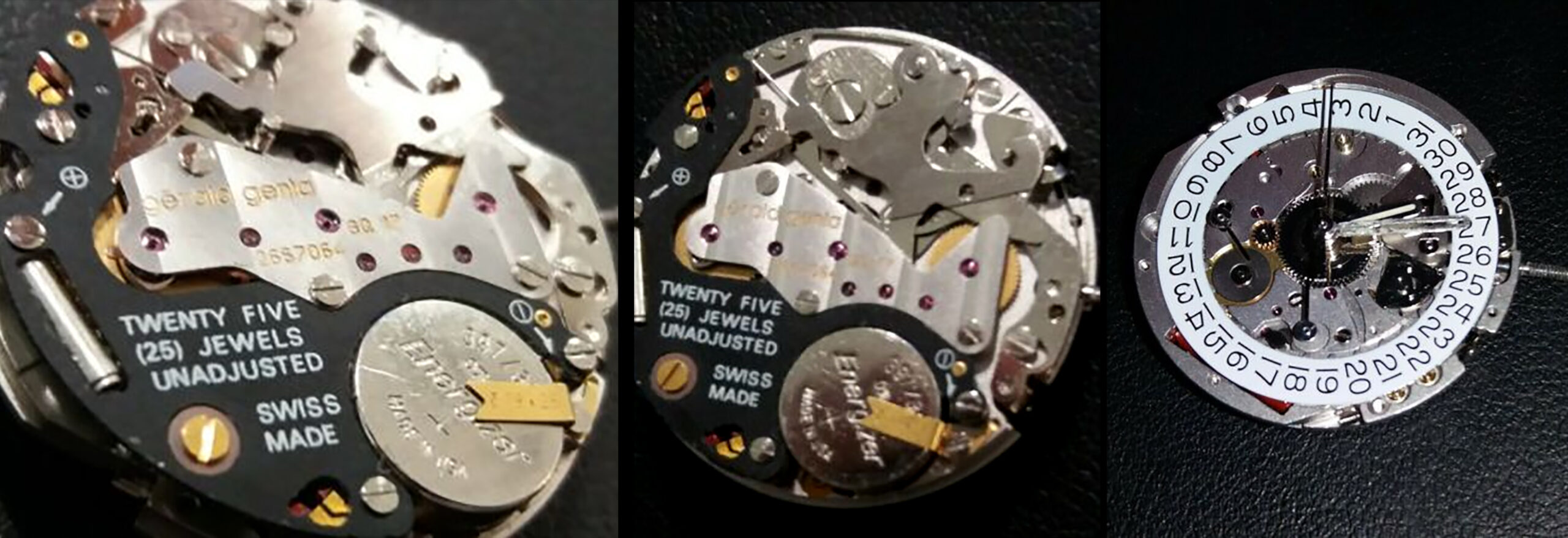
Funny enought I found a picture of the caliber JLC 630 signed “gerald genta” IWC Chronograph Mecaquartz on sale.
More in general Mecaquartz chronographs use movements of a hybrid construction. These movements join a quartz-regulated electronic timekeeping engine and a mechanical chronograph module. Mecaquartz chronographs have the accuracy and stability of quartz, the handling of a mechanical chronograph, and a physically compact package. The biggest disadvantage of these movements is the dependence on a battery.
Quartz watches with an “analog” display use a small stepper motor to drive the watch hands. Mecaquartz movements use a second, separate stepper motor to drive the chronograph module. A gear-train translates the motor drive into movement of the chronograph hands. The chronograph motor operates at a higher frequency than the one-tick-per-second of the timekeeping motor. This gives the chronograph a smoother sweep and allows the measurement of intervals with greater precision than full seconds. The reset lever operates on a heart-shaped cam so reset is mechanical and instantaneous.
By way of contrast, a conventional quartz chronograph uses separate motors to drive each counter on the dial. The hands are advanced by the circuitry when the chronograph is activated by the pusher. When the chronograph is reset the motors move their hands to zero.
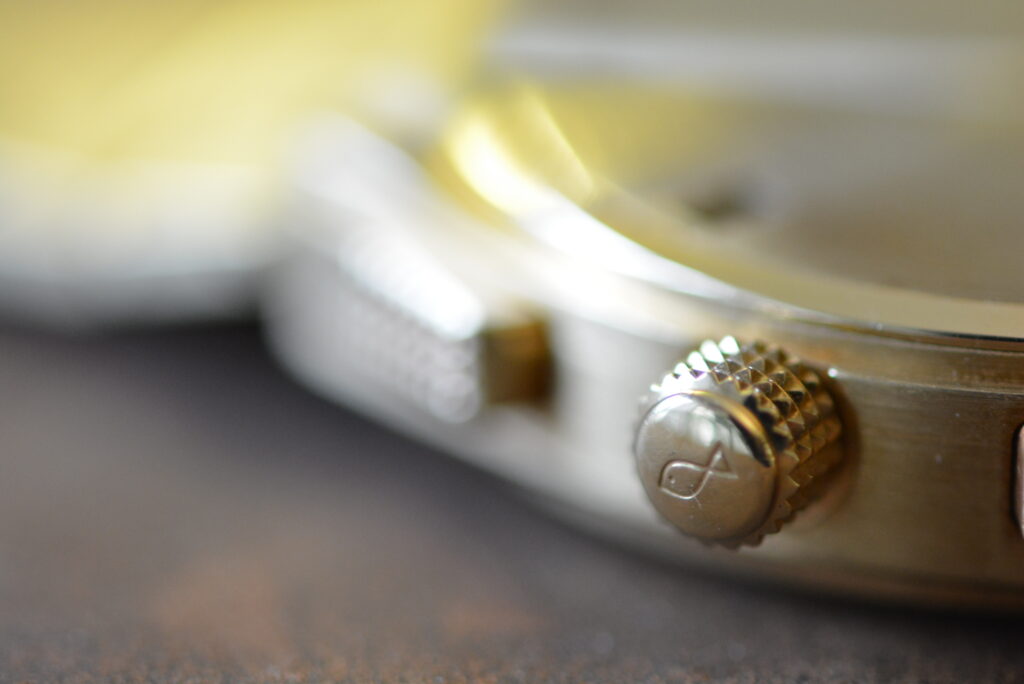
Hour-minute crown setting. Clou de Paris grip.
Back to the case construction. The pushers are relevant to the case finishing. Paired with a similar pavè (or Clou de Paris) finishing, they enhance the grip and well reflect the light to enrich the overall complex experience of the case distribution. It is a detail that so deeply enrich the aesthetic of the case finishing that the detail would go unnoticed if not paid enough attention to detail, It was here, looking and this very tiny detail that attract my attention and make me feel the wish to try out. I did noticed the wath shown on the glass box, but once I picked it up in my hand, the heft weight and the overall richness in detail totally win me over. Some watch you really have to try out to fully understand their value and richness in design and construction.
he material available for this reference, and in general that year’s references are quite scarce and fragmented. I did manage to find a 1993’s publication of the “125 years of IWC”. At my surprise the price tag of this watch, back in the days, used to be a whopping 22.000 $, today worth 46 000 euro. A massive amount of money for a watch in general, even more in perspective it is the price for a quartz. Today the price tag for the type of movement would sound insane, since high end quartz movements can be experienced with relatively little or no brand. I just recall Grand Seiko with a top grade quartz movement, but the price is still “reasonable” in comparison.
What to say more. If you have the opportunity, try out. You will not regret it.