


Janus Lab Italy
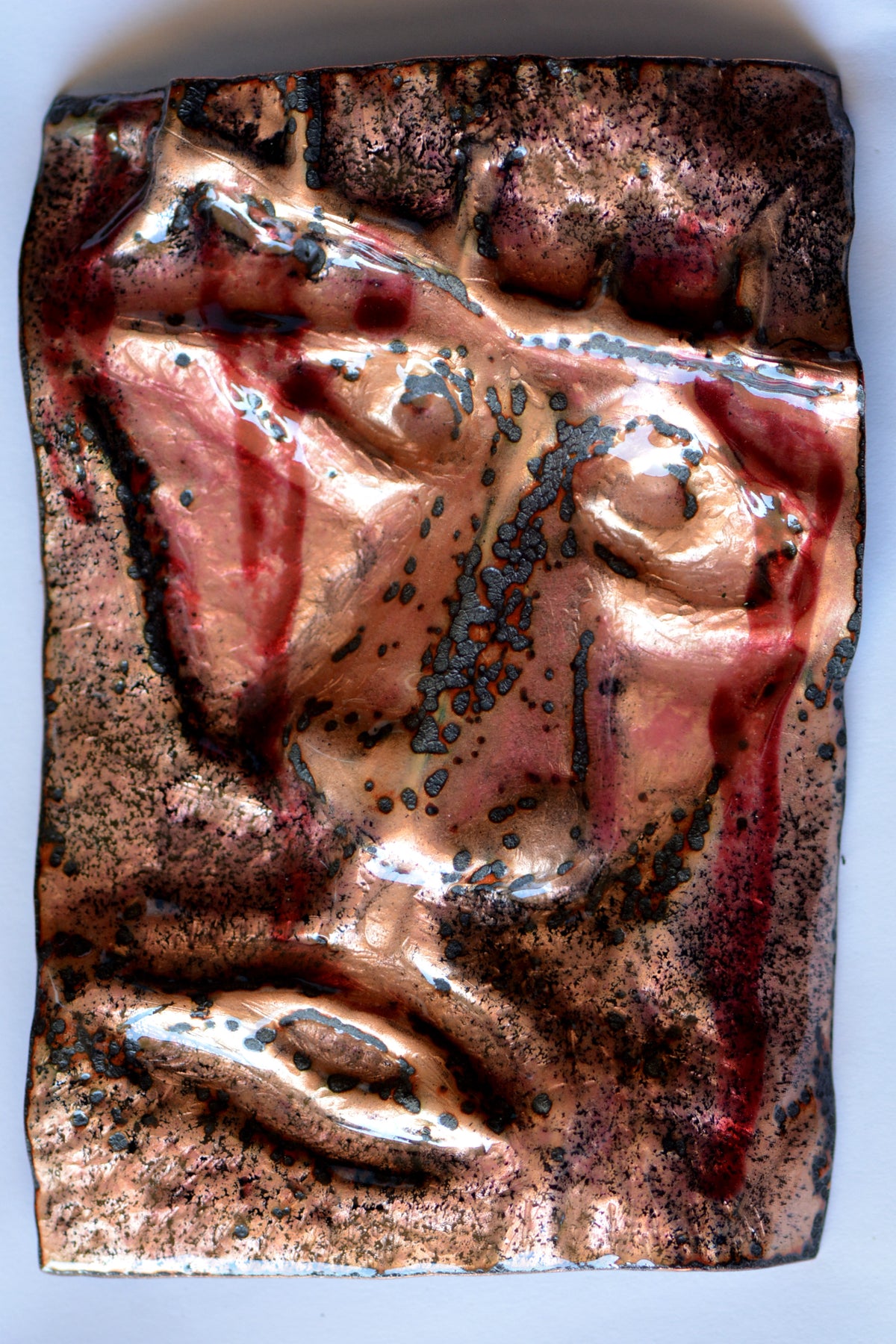
Cristo Cade con la Croce
Cristo Cade con la Croce
Inspired by a work by Gaetano Previati housed at the Diocesan Museum.
Jesus falls for the first time. The tension of the scene is contained within the constraints of the metal panel: the spatial dimensions must be precise. The angle of the face is carefully calculated in its reinterpretation of the original reference work. The context is kept minimal and essential. The plasticity of the material is emphasized and harnessed to convey the drama of the event. The material’s inherent plasticity—the depressions and protrusions on its surface, shaped by oxidation—serves to heighten the depth of the face, the intensity of the scene, the tragic nature of the suffering, and the expression itself. While a faithful, literal reproduction might capture the face’s features more accurately, it would obscure a personal interpretation of the expression. Furthermore, a perfectly sculpted surface in bare copper might satisfy the formal composition of the face, but it would fail to allow the material to express itself through its own evolution, deformation, and oxidation. A "perfect" face is not human; moreover, a purely sculptural approach would prevent the enamel from engaging in a dialogue with the copper. On a perfectly smooth, pre-formed surface, enamel would merely add a sheen—sitting atop the metal rather than truly combining or reacting with it. The copper is shaped using the *repoussé* technique, yet it employs a contrasting punch to deform the surface in a way that is calculated rather than strictly sculptural. This is not the work of a sculptor who merely removes, lowers, or rounds material; rather, it is the result of two opposing forces seeking balance upon a malleable surface. Streaks of red and oxide distort the face, accentuating its hollows. Black enamel, set against a transparent flux over the warm tone of the copper, frames the face, defining the beard and the head.
Share


Enamel - Le Grand Feu
“Smalti a Fuoco_ Un’arte di Sottecchio”
The art of fire enameling is an ancient and highly complex craft.
Rooted in precise gestures and knowledge acquired over time, it has, through the centuries, transformed simple metals—such as copper or silver—into objects of great value and artistic significance.
Today, it is largely confined to a few specialized creations and is often mistaken for industrially produced items or those made with polymer-based enamels. As a result, it remains mostly associated with traditionally styled aesthetic prototypes.
Only in rare cases has it broken free from classical aesthetics, giving rise to modern works crafted using ancient techniques—thanks to great, though now nearly forgotten, artisans.
These are the foundations of our own deeply personal journey: not only a rediscovery of enamel’s potential, but also a search for a new, contemporary language—one that reimagines how fire enameling can still express beauty and sophistication today.
The Origin of ...
Stories of ancient civilizations lost to time—where traces begin to resurface through climate change and environmental degradation. Both in icy regions and equatorial rainforests, new signs of past civilizations emerge.
Starting from those same carved stones—faces sculpted by ancient hands—I began to wonder about human expression: how to represent it, how to give it form. I started experimenting with shaping expressions -mimicking ancient relics- on copper, sculpting the metal and recreating those same lines. The hammer transforms the material in two ways: on one side it expands and deforms the surface; on the other, it leaves marks rich with texture.
It became inevitable for me to begin sculpting real faces, seeking to capture their emotions—their wonder, sadness, and joy. I am fascinated by how ancient civilizations, and more broadly by how cultures, have sought to depict their people—their identity, their symbolism, their spirit. That is the path this project follows.